Summary
- Popularity trend: Java is #1, Kotlin #2, and Scala #3. Kotlin lost 22% of its job ad mentions in the last two months. So Java pulls away again, despite shedding 4% on its own. And Scala lost 9% but still gained slightly on Kotlin.
- On your current project, keep your existing language unless that language is absolutely, really not working out for you.
- If you need to switch languages or are on a new project:
- Use Scala if you need functional programming.
- Use Kotlin if you really need a “more modern Java”.
- Otherwise, use the latest Java LTS version you, your team, and your application can take.
Archive
| April 2022 | March 2022 | February 2022 | January 2022 | December 2021 | November 2021 |
Table Of Contents
Applications
These recommendations are for building enterprise applications on PCs and mobile devices - forms, data grids, reports. They are not for games or media applications.
Choices
Here are the choices in alphabetical order:
Popularity
Why Popularity - and How?
Picking a popular technology makes our developer life easier: Easier to learn, easier to build, debug & deploy, easier to hire, and easier to convince teammates & bosses. Now popularity can make a difference in two situations: When multiple technologies score the same, we could go for the most popular one. And when a technology is very unpopular, we may not use it.
I measure popularity among employers and developers as the trend between competing technologies. I count mentions in job ads at Indeed for employer popularity. For developer popularity, I use Google searches, Udemy course buyers, and Stack Overflow questions.
Employers: Job Ads
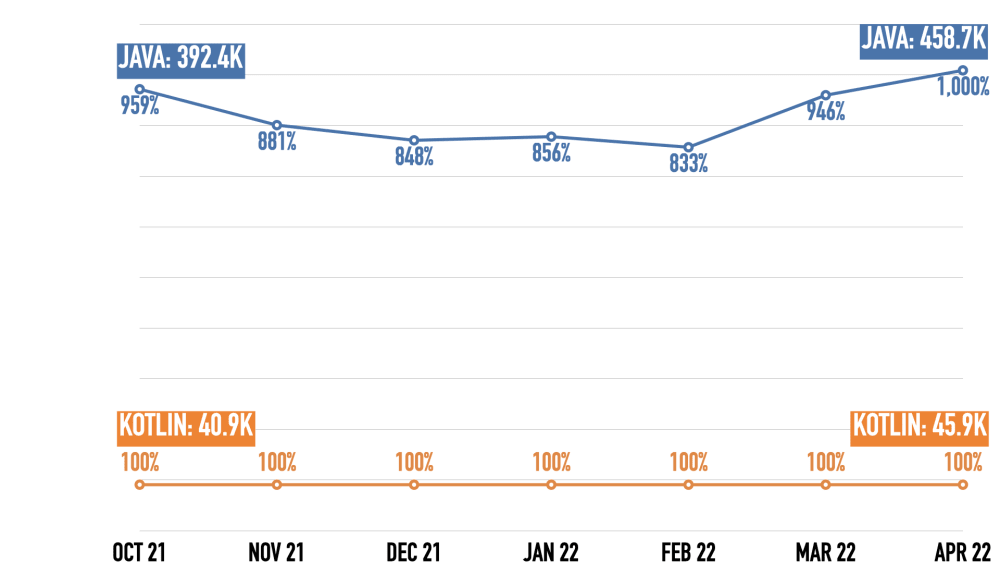
The Indeed job search is active in 62 countries representing 89% of the worldwide GDP in 2020. It demonstrates the willingness of organizations to pay for technology - the strongest indicator of popularity in my mind. Kotlin is the baseline.
And here are the remaining languages:
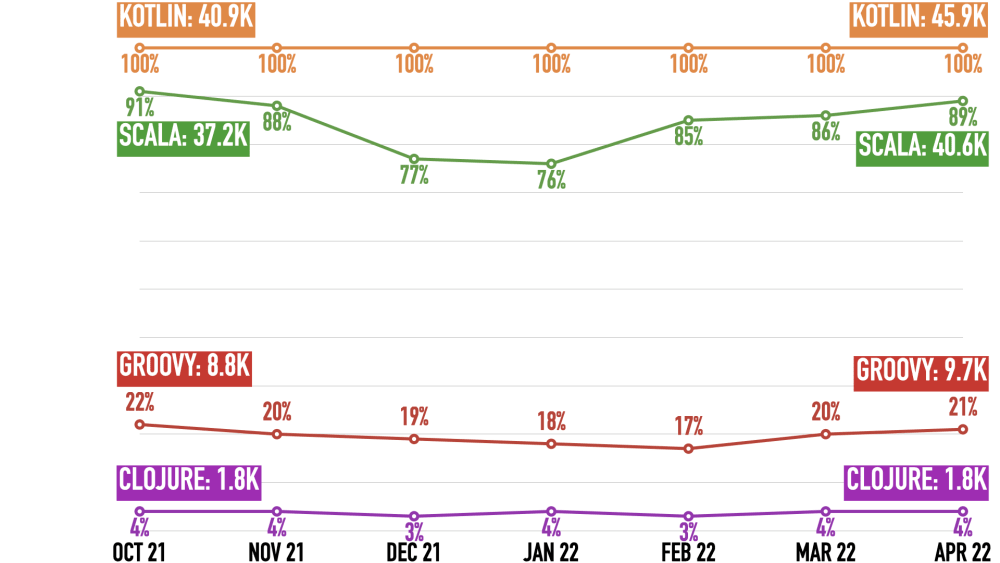
Java wins by an order of magnitude, Kotlin is second, Scala a close third. Groovy has a fifth of Kotlin’s number while Clojure is last. Kotlin lost a lot over the last months, wiping out all gains against Java & Scala since last October. Even Groovy and Clojure gained against Kotlin.
Please see here for details, caveats, and adjustments of the job ad mentions.
You can find the detailed search results with links here. They include breakdowns by continents:
Developers
Google Searches
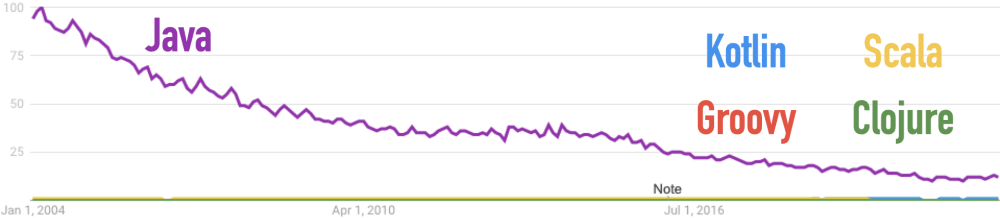
Google Trends demonstrates the initial interest in a technology over time:
This link produces the chart above.
Even at 1/8 of its peak interest in 2004, Java still towers over all its JVM alternatives. Its decline seems to have stopped.
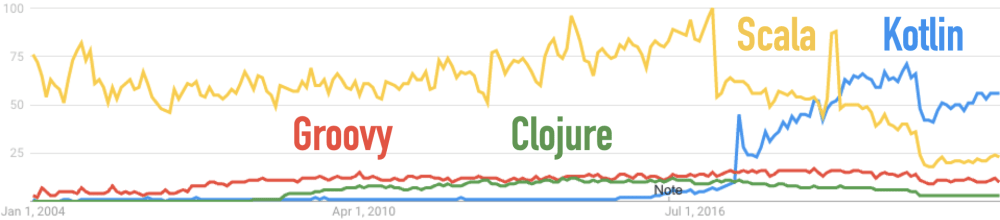
To get a better picture of the Java alternatives, here they are without Java:
This link produces the chart above.
Among the Java challengers, Kotlin wins, Scala is second, Groovy third, and Clojure last. We can see the fall of Scala and the rise of Kotlin, both starting five years ago. Kotlin peaked in July 2020 and is now back to 2018 levels. Scala stabilized a year ago. Groovy has declined for nearly three years, while Clojure has for almost four years.
Students at Udemy
Udemy is one of the biggest online learning sites. They publish the number of courses and students (beyond a certain threshold). This shows how many people evaluate a technology. Kotlin is the baseline.
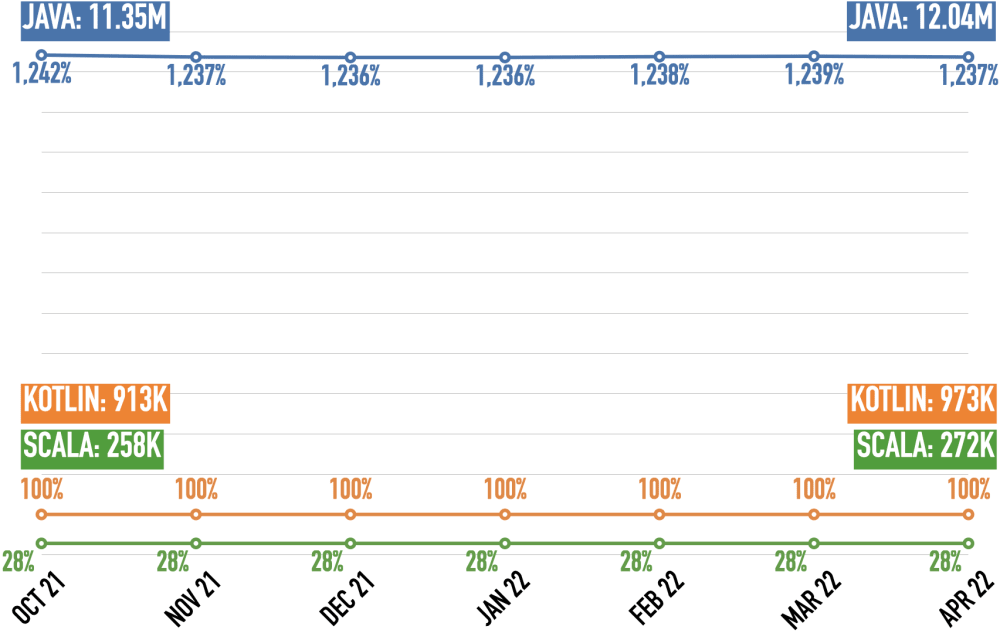
Java wins by an order of magnitude, Kotlin is second, and Scala is third. Java, Kotlin, and Scala are stable. Both Groovy and Clojure don’t have enough students to cross the display threshold.
Note: Because of an error, I reported Scala at 27% and 26% in the previous reports. That was wrong.
Here are the links that show the courses for all and the number of students for some:
Questions at Stack Overflow
Stack Overflow Trends shows which percentage of questions at Stack Overflow has a particular technology tag. It is a proxy for using a technology during evaluation and productive use. “More questions = better” to me.
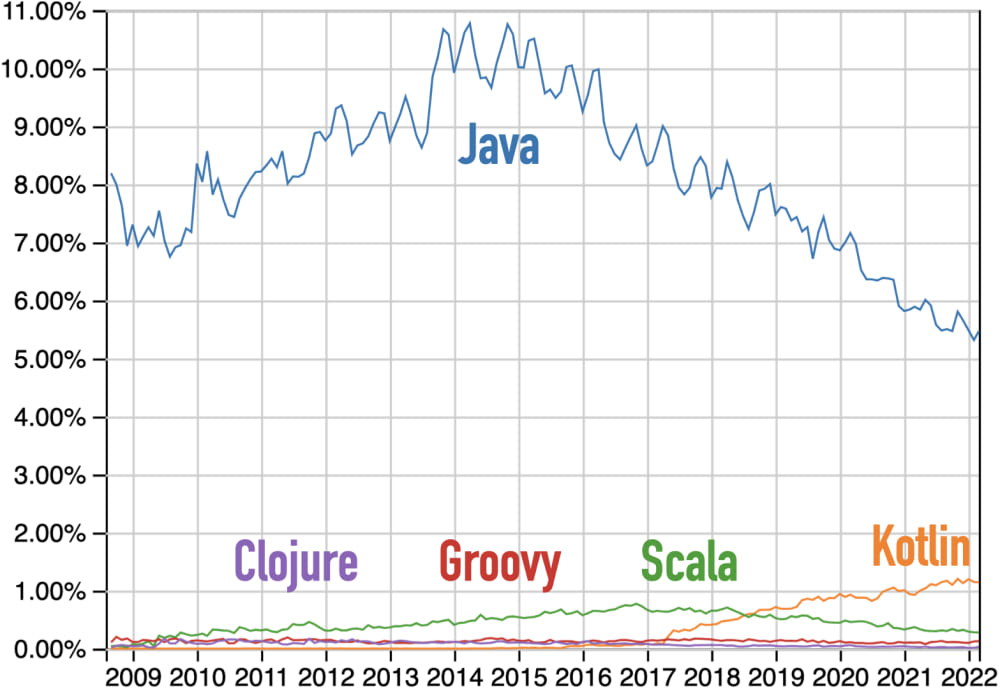
This link produces the chart above.
Java wins, Kotlin is second, Scala third. After a five-year rise, Kotlin seems to plateau at a fifth of Java’s question volume. Java has declined for seven years, while Scala has fallen for five years. Groovy and Clojure have hovered just above zero for as long as Stack Overflow has existed.
Analysis
- Usage of Java still dominates its alternatives, often by an order of magnitude.
- The evolution speed of the Java languages has increased. So even staying with the incumbent Java makes life for us developers easier.
- If Oracle gets its will, then we’ll get a new Java LTS every two years instead of every three years. This would speed up the delivery of Java language improvements.
- Kotlin is the best Java alternative. I believe that Kotlin’s rise in popularity is in part fueled by its status as the default language for Android development.
- Scala lost its position as the #2 JVM language. In job ads, it’s still neck-to-neck with Kotlin and even comfortably ahead of it in places like North America (where it leads Kotlin 2:1). But Kotlin leads globally in job ads. And Google searches and Stack Overflow questions also trend towards Kotlin. That’s why Scala is #3 for me.
- There’s one overwriting factor that requires Scala: functional programming. If that’s your need, you have to use Scala on the JVM.
- Groovy is a has-been on the JVM: Kotlin stole its place of “better Java”, while Grails (Ruby-on-Rails with Groovy on the JVM) has fallen out of favor. I know that the Tiobe Index places Groovy way ahead of other JVM language alternatives to Java, but I think that view is rather exclusive to Tiobe.
- Clojure fills the niche of “Lisp on the JVM”.
Here’s my recommendation:
- On your current project, keep your existing language unless that language is absolutely, really not working out for you.
- If you need to switch languages or are on a new project:
- Use Scala if you need functional programming.
- Use Kotlin if you really need a “more modern Java”.
- Otherwise, use the latest Java LTS version you, your team, and your application can take.