Summary
- Popularity trend: After an Angular surge last September, employers increased React’s lead over Angular again. Among developers, Angular also falls behind React but keeps Vue at bay.
- If you already use React, Angular, or Vue in your project, then keep using them. Otherwise, evaluate a migration. In many (most?) cases, such migration doesn’t make business sense.
- If you start a new project or do migrate, then start with React first, Angular otherwise, and finally Vue.
Archive
| February 2022 | January 2022 | December 2021 | November 2021 |
Table Of Contents
Applications
These recommendations are for building web enterprise applications on PCs and mobile devices - forms, data grids, reports. They are not for games or media applications.
Choices
- Google’s Angular
- Jakarta Server Faces (was JavaServer Faces)
- Facebook’s React
- Thymeleaf
- Vaadin
- Vue (“Vue.js” is the correct but longer name)
State of the Art
Declarative UIs are state of the art. Learn about it here.
Popularity
Why Popularity - and How?
Picking a popular technology makes our developer life easier: Easier to learn, easier to build, debug & deploy, easier to hire, and easier to convince teammates & bosses. Now popularity can make a difference in two situations: When multiple technologies score the same, we could go for the most popular one. And when a technology is very unpopular, we may not use it.
I measure popularity among employers and developers as the trend between competing technologies. I count mentions in job ads at Indeed for employer popularity. For developer popularity, I use Google searches, Udemy course buyers, and Stack Overflow questions.
Employers: Job Ads
The Indeed job search is active in 63 countries representing 92% of the worldwide GDP in 2020. It demonstrates the willingness of organizations to pay for a technology - the strongest indicator of popularity in my mind. Angular is the baseline. With 0.6% and 0.4%, respectively, Thymeleaf and Vaadin are missing from the chart.

React wins, Angular is second, Vue third. After an Angular surge last September, React is pulling away from Angular again. Vue is slowly gaining on Angular and has nearly reached half of Angular’s mentions. JSF is an order of magnitude behind Vue.
Please see here for details, caveats, and adjustments of the job ad mentions.
You can find the detailed search results with links here. They include breakdowns by continents:
Developers
Google Searches
Google Trends demonstrates the initial interest in a technology over time. Thymeleaf is not on the list because Google only allows 5 search terms. “More searches = better” to me.
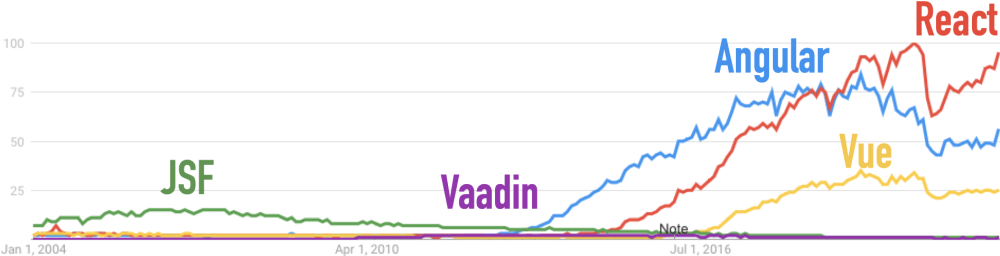
This link produces the chart above. Here’s a version with Thymeleaf instead of Vaadin: Thymeleaf also flat-lines.
React wins, Angular is second, Vue third. While Angular peaked in July 2019, React and Vue peaked a year later. React and Angular grow again while Vue remains flat. All other frameworks are insignificant against these three.
Students at Udemy
Udemy is one of the biggest online learning sites. They publish the number of courses and the number of students (beyond a certain threshold). This shows how many people evaluate a technology. Angular is the baseline. The other frameworks don’t cross the reporting threshold for Students at Udemy (maybe around 100,000 students).

React wins, Angular’s second, Vue is third. React is steadily increasing its lead over Angular. Vue is stuck at 40% of Angular’s students.
Here are the links that show the courses for all and the number of students for some:
Questions at Stack Overflow
Stack Overflow Trends shows which percentage of questions at Stack Overflow has a particular technology tag. It is a proxy for using a technology during evaluation and productive use. “More questions = better” to me.
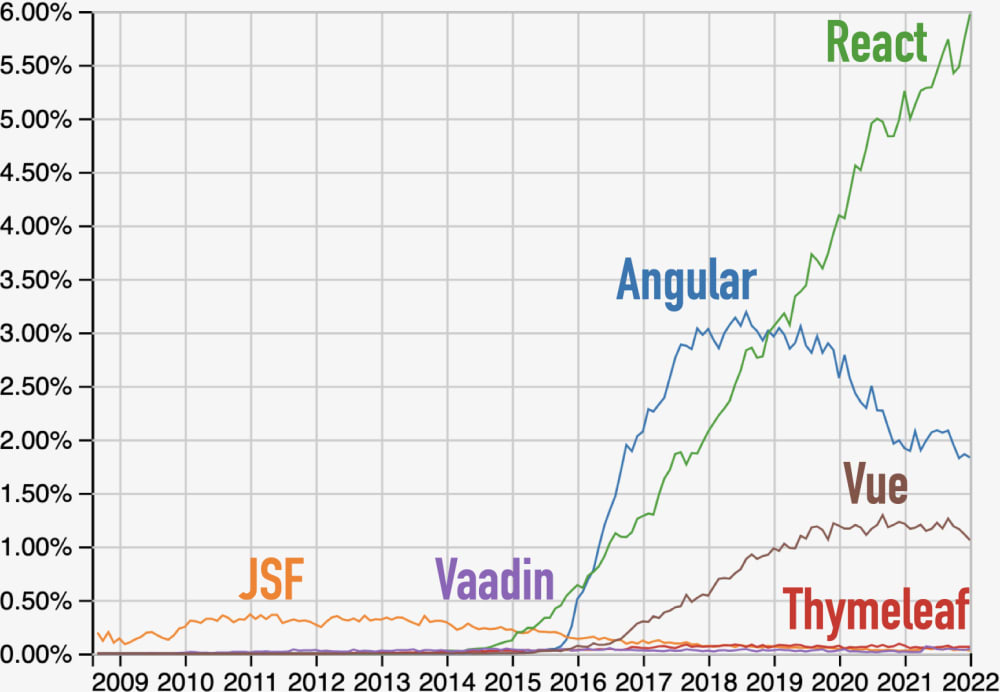
This link produces the chart above.
React wins, Angular is second, Vue third. React has grown spectacularly for seven years. Angular has declined for about 3.5 years, Vue for the last couple of months. JSF, Vaadin, and Thymeleaf barely measure against the “Big Three”.
Analysis
I use the following criteria to recommend one of the three choices - Angular, React, and Vue:
- Java: Angular wins here because it uses Typescript by default. Typescript is closer to Java than plain JavaScript.
- Declarative: Declarative is state-of-the-art for front-end development. Please see my guide for it. React uses it by default. Angular does not, so React wins.
- Safe: Google has the image of killing projects and has multiple competing front-end frameworks. That’s why I’m more confident that React will still be around in five years.
- Popular: As you can see above, React is the most popular framework.
- Web functionality: It’s a draw as all three frameworks can build the kind of applications we need.
- Libraries: I don’t know which of these three frameworks has the most and best libraries. I think many libraries work in all three.
- Speed: I think you can build the fastest applications with React because it has features to speed up the concurrent loading of components.
- Build, Deploy & Debug: I don’t know which of these three frameworks has the shortest build & deploy cycle and the best debug experience.
Based on these criteria and my ratings, React is the winner, Angular second, and Vue third. My recommendation is this:
- If you already use React, Angular, or Vue in your project, then keep using them.
- If you use another framework, then investigate migration to React first, then Angular, and finally Vue. In many (most?) cases, such migration doesn’t make business sense.
- If you start a new project, then start with React first, Angular otherwise, and finally Vue.