Summary
- On your current project, keep your existing back-end framework unless that framework is absolutely, really not working out for you.
- If you need to switch back-end frameworks or are on a new project:
- Use Quarkus if you need the smallest possible, fastest-starting Java application now.
- Otherwise, use Spring Boot.
Table Of Contents
Archive
Applications
These recommendations are for building enterprise applications on PCs and mobile devices - forms, data grids, reports. They are not for games or media applications.
Choices
Here are the choices in alphabetical order:
- Dropwizard
- Oracle’s Helidon
- Eclipse Jakarta EE (was Java EE before)
- Micronaut
- Eclipse MicroProfile
- VMWare’s Spring Boot
- Red Hat’s Quarkus
Popularity
Why Popularity - and How?
Picking a popular technology makes our developer life easier: Easier to learn, easier to build, debug & deploy, easier to hire, and easier to convince teammates & bosses. Popularity can make a difference in two situations: When multiple technologies score the same, you could go for the most popular one. And when a technology is very unpopular, we may not use it.
Now I look at technology popularity as a funnel from interest to learning, application, and finally to skill:

- Quantity decreases in the funnel - we’re interested in many technologies, but few end up on our resumes.
- Time increases in the funnel - it takes many months, often years, for technology to move from “interest” to “skill”.
We’re interested in the trend of the ratio between competing technologies. So we use Google searches to measure interest, Udemy course buyers to measure learning, Stack Overflow questions to measure learning & application, and mentions in Indeed job ads to measure skills.
Google Searches
Google Trends demonstrates the initial interest in a technology over time. Here are all frameworks, but Helidon - Google Trends only allows five at the same time:
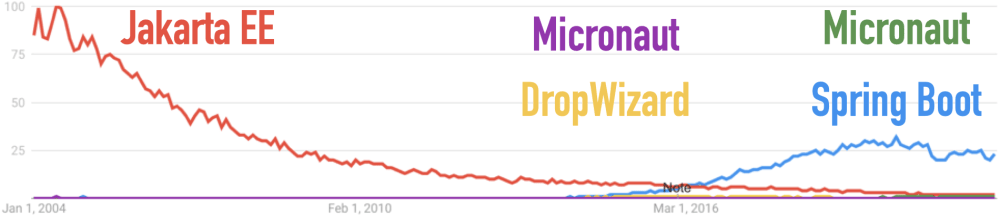
This link produces the chart above. This version switches in Helidon for Micronaut, and this one MicroProfile - which isn’t making a difference in the chart.
Spring Boot wins, and Jakarta EE is second. Jakarta EE’s decline in popularity here is stunning. Spring Boot peaked in February 2020. It currently leads Jakarta EE by a factor of 10x.
We can’t pick a third place in the chart, so let’s zoom in on the five challengers over the last two years:
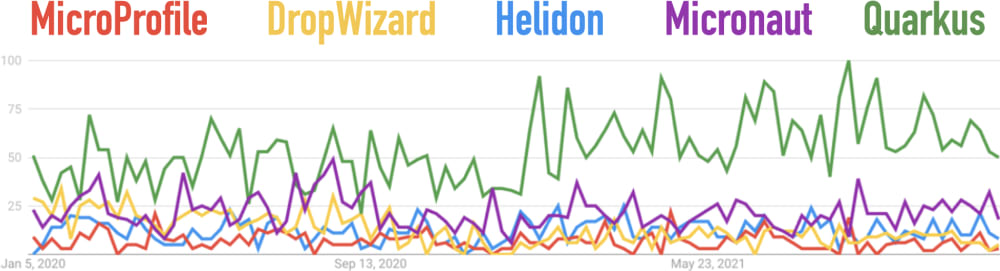
This is the link for the chart.
So Quarkus leads ahead of Micronaut and Helidon. Quarkus zig-zagged in 2021 and peaked last September.
How does Jakarta EE fare against Quarkus?
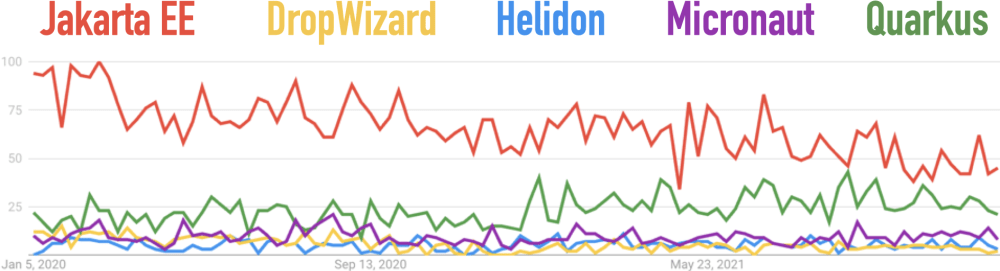
Here’s the link for this chart.
Jakarta EE lost half of its search query volume over the last two years. It briefly stabilized in the first half of 2021 but is now trending down again. It’s unclear if and when Quarkus would pass Jakarta EE.
Students at Udemy
Udemy is one of the biggest online learning sites. They publish the number of courses and the number of students (beyond a certain threshold). This shows how many people evaluate a technology. I compare the number of students in November (“Nov 21) with the number from December (“Dec 21”). Jakarta EE is the baseline. The other technologies haven’t crossed the reporting threshold for Udemy (maybe around 100,000).
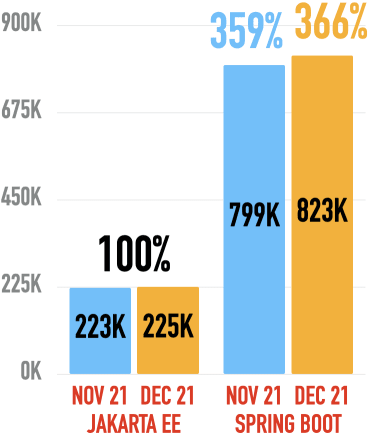
So Spring Boot wins ahead of Jakarta EE with 3.5 times as many students. Spring Boot increased its lead slightly.
Here are the links that show the courses for all and the number of students for some:
Questions at Stack Overflow
Stack Overflow Trends shows which percentage of questions at Stack Overflow has a particular technology tag. It is a proxy for using a technology during evaluation and productive use. “More questions = better” to me.
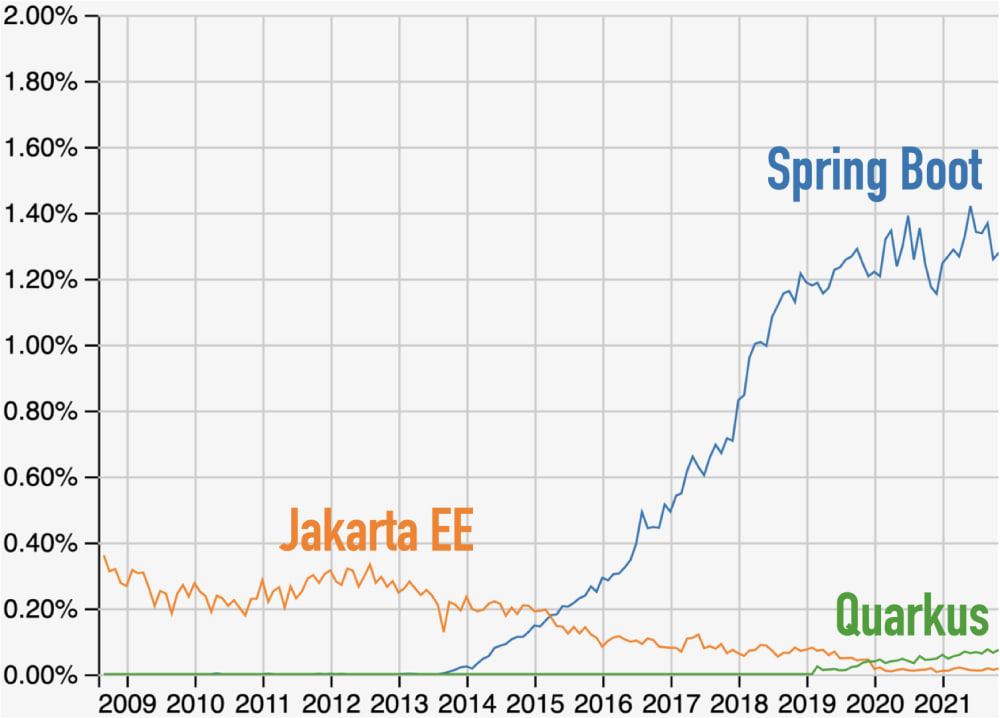
This link produces the chart above.
Spring Boot wins by an order of magnitude, while Quarkus places second and Jakarta EE third. Spring Boot declined in the last six months to a mid-2019 level. Jakarta EE is flat while Quarkus slowly grows. DropWizard, Helidon, Micronaut, and MicroProfile don’t have a tag on Stack Overflow.
Job Ads at Indeed
The Indeed job search is active in 63 countries representing 92% of the worldwide GDP in 2020. It demonstrates the willingness of organizations to pay for a technology - the strongest indicator of popularity in my mind. I compare mentions in job ads from November (“Nov 21”) against measurements from December (“Dec 21). Jakarta EE is the baseline.
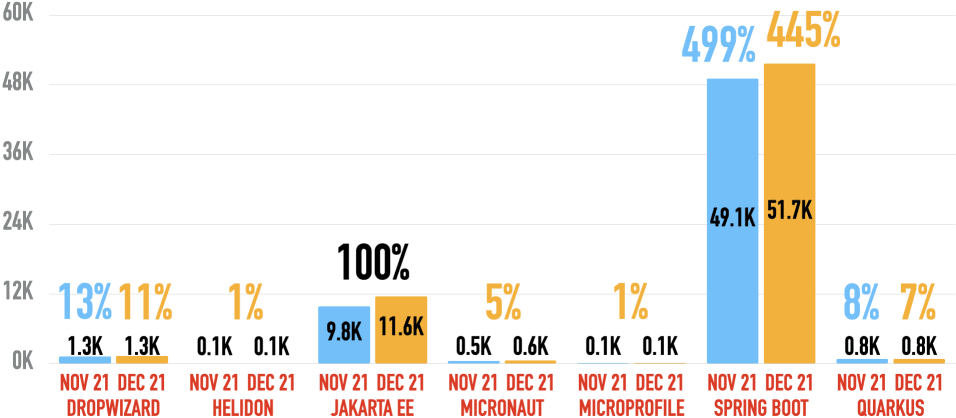
Spring Boot wins, and Jakarta EE is second. Jakarta EE is on a surge, closing part of the gap with Spring Boot. After that, the numbers are weak. Helidon and MicroProfile are barely mentioned.
Please see here for details, caveats, and adjustments of the job ad mentions.
You can find the detailed search results with links here. They include breakdowns by continents:
Analysis
- Spring Boot dominates the Java ecosystem. So has the broadest support of libraries and third-party software working out of the box, conveniently configured the same way as Spring Boot. Its biggest weakness is the lackluster support for creating native executables: The resulting applications use more memory and start up slower than, say, Quarkus applications, and not all of the Spring Initializer libraries work natively. We’ll have to wait for Spring Boot 3 in late 2022 at the earliest to get really competitive memory usage and start-up times. And even then, some of the Spring Initializer still may not work natively.
- Jakarta EE is a vendor-independent specification with multiple implementations. It has had a rough couple of years: First, Oracle neglected it when it was still called “Java EE”. Oracle grudgingly transferred it to the Eclipse Foundation but required renaming all packages from
javax.*tojakarta.*. So even though Jakarta EE saw three releases since 2019, I think relatively little functionality has changed since Java EE 8 in August 2017. But the more significant issue is that Jakarta EE was designed for application servers like IBM WebSphere that host many applications on big and expensive servers. We’re rapidly moving into a world where our Java applications run as close to the metal as possible, all by themselves as microservices in small containers or even serverless. This world has no place for application servers anymore. Will it have one for Jakarta EE? Only time will tell. - MicroProfile is “Spring Boot with more Jakarta EE parts”, but without its broad support of libraries and third-party software. It started out of frustration with the slow progress of Java EE in 2016. Just like Jakarta EE, it is a vendor-independent specification with multiple implementations. It’s probably the least popular framework here, based on my measurements.
- Dropwizard is a framework that I had never heard of until the “JRebel 2021 Java Technology Report” declared it the #2 Java framework. Its origins seem to go back to 2012. It has the most job ad mentions besides Spring Boot and Jakarta EE.
- Quarkus is Red Hat’s take on a cloud-native Java framework. “Cloud-native” means producing small and fast applications: Quarkus claims 12 MB RAM for a REST application that starts up in 0.016 seconds. It has the most mind-share as the cloud-native Spring Boot competitor. It’s the most popular framework besides Spring Boot and Jakarta EE, except for Job ads where it trails Dropwizard.
- Micronaut is the second cloud-native Spring Boot competitor. It’s backed by consulting company Object Computing, which sponsors Grails and is less popular than Quarkus.
- Helidon is the third and least popular cloud-native Spring Boot competitor. It’s an Oracle framework.
So here’s my recommendation:
- On your current project, keep your existing back-end framework unless that framework is absolutely, really not working out for you.
- If you need to switch back-end frameworks or are on a new project:
- Use Quarkus if you need the smallest possible, fastest-starting Java application now.
- Otherwise, use Spring Boot.